COVID


Entry DateCategoriesTitleContenthf:doc_categories
December 16, 2025COVIDCOVID-19 increases the risk of asthma exacerbation – UK study (2020-21)

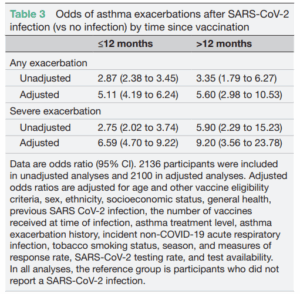
A UK prospective study (conducted in 2020-2021) including 2100 people with asthma (that had had a vaccine booster in the past) reported that getting a COVID-19 infection increased the risk of asthma exacerbation by:

  • 5 fold for any asthma flare-up (adjusted OR 5.11 (4.19 to 6.24) for booster within 12 months and 5.60 (2.98 to 10.53) for booster over 12 months ago)
  • 6 to 9 folds for severe asthma flare-ups (requiring OCS, ED visit or hospitalisation), depending on the time since the booster was received , although the difference in risk between under and over 12 months was not statistically significant: adjusted OR 6.59 (4.70 to 9.22) for booster within 12 months and 9.20 (3.56 to 23.78) for booster over 12 months ago
  • these results were adjusted/controlled for asthma treatment level (severity) and history of past flare-ups, amongst other potential confounders.

This study indicates that having a COVID infection continues to increase the risk of asthma flare-up in people with asthma, independently of asthma severity and asthma exacerbation history.

While the results suggest that longer time since vaccination increases the risk of severe asthma exacerbation, the difference was not statistically significant (confidence intervals overlap) and this requires further investigation.

covid viral-infections
July 28, 2023COVIDExperiences of Australians throughout the COVID-19 pandemic (Lung Foundation, 2022) – Resource

Report/Information paper by the Lung Foundation that discusses the results from their national survey (2196 responses) about the experiences of Australians throughout the COVID-19 pandemic and the impact of ongoing COVID-19 symptoms, particularly for the lung disease community. This report outlines the following:
– Experience of Australians through the pandemic
– Experience of Australians living with a lung disease or other chronic condition
– Experience of carers
– Healthcare access
– Mental health
– Immunisation
– The view of Australians on disease prevention, the future and government trust
– Recommendations

covid viral-infections
July 20, 2022COVID, Emergency Department Presentations, HospitalisationEffect of COVID on asthma – AIHW

Extract from AIHW Chronic respiratory conditions report:

COVID‑19 impact on chronic respiratory conditions

The COVID‑19 pandemic had substantial impacts on hospital activity generally. The range of social, economic, business and travel restrictions, including restrictions on, or suspension of, some hospital services, and associated measures in other healthcare services to support physical distancing in Australia, resulted in an overall decrease in hospital activity between 2019–20 and 2020–21. As a result, the hospitalisation rates for asthma and COPD in these years were the lowest recorded in the last 10 years (AIHW 2022a).

For more information on how the pandemic has affected the population’s health in the context of longer-term trends, see ‘Changes in the health of Australians during the COVID‑19 period’ in Australia’s health 2022: data insights.

Emergency department presentations for asthma and COPD were also affected by the pandemic, decreasing from March (when the national lockdown started) to May 2020 (from 26 to 11 and 39 to 28 presentations per 100,000 population, respectively).

In June 2020, emergency department presentations increased again as restrictions began to ease across the country (to 19 presentations per 100,000 population for asthma and to 33 presentations per 100,000 population for COPD) (Figure 9).


During the COVID‑19 pandemic (as at 31 October 2022), chronic respiratory conditions were certified as a pre-existing condition in 18% of the deaths with a chronic condition mentioned, the third highest of all chronic conditions (ABS 2022)

Death rates due to all respiratory diseases combined also showed a substantial fall in 2020, with rates particularly low for females and during the winter months compared with previous years, though rates have increased since (Figure 10).

While the long-term impact of COVID‑19 on the respiratory system is still being assessed, evidence shows that COVID‑19 does not directly impact the risk of increasing asthma severity and vice versa (Lee et al. 2020; Lieberman-Cribbin et al. 2020; Mather et al. 2021). However, there is increasing evidence showing that COPD patients with COVID‑19 have greater risk of mortality, severity of infection and higher likelihood of requiring Intensive Care Unit (ICU) support than those without COPD (Cazzola et al. 2021; Clark et al. 2021; Wells 2021).

For more information, see ‘The impact of a new disease: COVID‑19 from 2020, 2021 and into 2022’ in Australia’s health 2022: data insights.

covid emergency-department-ed-presentations hospitalisation viral-infections
May 19, 2022COVIDKey guidelines for COVID and asthma – Resources

Key Guidelines:
– Australian Asthma Handbook, v2.2, COVID webpage (ref 1)
– GINA COVID guidance (ref 2)
– Severe asthma toolkit: Clinical recommendations for COVID-19 in Severe Asthma + several infographics for people with severe asthma (ref 3)

Infographics can be accessed here: https://toolkit.severeasthma.org.au/resources/infographics/

covid viral-infections
May 19, 2022COVIDKey messages about asthma and COVID

key messages:
* People with asthma face no greater risk of becoming infected with COVID.(2)
* People with well-controlled asthma are not at greater risk of severe illness, going to hospital or dying from COVID, however people with severe or uncontrolled asthma (e.g. have needed oral corticosteroids or were hospitalised in the last 12 months) are. (1-6)

covid viral-infections
April 13, 2022COVIDCOVID hospitalisation among people with asthma, multiple sources

HOSPITALISATION:
– Adult patients with a history of asthma attack requiring oral corticosteroids (OCS) or hospitalisation are at increased risk of COVID hospitalisation, compared to patients without asthma. (1) Specifically:
– patients with a history of one or more asthma attacks in the last 2 years, defined as receiving one or more course of oral corticosteroids, had an adjusted HR between 1.30 (one course) and 1.54 (3 or more courses). (1)
– patients hospitalised for asthma in the last 2 years were about 3 times more likelly to be hospitalised for COVID than patients without asthma (adjusted HR 3.01), although this was calculated based on a small group of patients (201 patients with asthma hospitalisation). (1)

– in a Scottish study, children aged 5-17 years with uncontrolled asthma (defined as hospital admission or oral corticosteroids prescription in the last 2 years) had at increased risk of hospital admission for COVID, with a risk increased by at least 6-fold for those with a history of asthma hospitalisation, and at leat 3-fold for those with a history of at least 2 courses of OCS in the last 2 years. The rate of hospitalisation was higher in children with poorly controlled asthma compared to those with well-controled asthma or no asthma.(2)

– in a large national cohort study in England in adults and children aged 12-17 years old:(3)
– adults with asthma prescribed medium and high ICS had an elevated risk of COVID hospitalisation (fully adjusted HRs 1.53 and 1.52 respectively) compared to people without asthma.
– adults with asthma had a significantly higher risk of COVID hospitalisation, with those prescribed 2 or more courses of OCS in the year prior to the pandemic having an adjusted HR of COVID-19 hospitalisation of 1.94 compared to adults without asthma. => Nearly twice as likelly to be hospitalised for COVID
– children (12-17 yo) with asthma had a greater risk of hospitalisation compared to children without asthma, and was the greatest for children prescribed 1 (HR 2.58) or 2 or more (HR 3.80) courses of OCS in the year prior to the pandemic. => children prescribed OCS were more than twice as likelly to be hospitalised than children without asthma (nearly four times for children prescribed 2 or more courses).
Concl: People with asthma who recently required higher ICS dosage-based therapies (ie, have more severe disease) or who experience one or more exacerbations per year (ie, have poorly-controlled asthma) as measured by OCS prescriptions, are potentially at increased risk of hospitalisation (particularly those that required 2 or more courses of OCS).(3)

covid viral-infections
April 13, 2022COVIDCOVID deaths among people with asthma, multiple sources

MORTALITY:
– Adults with asthma have a similar risk of dying from COVID compared with people without asthma.(1)
– when hospitalised for COVID, People with severe asthma (16yo +) are more likely to die than people without asthma (adjusted Hazard Ratio 1.96; 95% CI 1.25-3.08).(2)
– In a Scottish study, the risk of death from COVID was increased in asthmatic patients with a 2-year history of 3 course or more of oral corticosteroids (adjusted HR 1.39) or asthma hospitalisation (adjusted HR 1.84) compared to patients without asthma. (3, supplementary material table S7)

– In a large national cohort study in England:(4)
– increased risk of COVID death in Adults with asthma prescribed medium and high ICS (adjusted HRs 1.18 and 1.36 respectively) compared to adults without asthma, but no significant increase in people with asthma prescribed low ICS.
– increased risk of COVID death in adults with asthma prescribed 0 (adjusted HR 1.10), 1 (adjusted HR 1.20), 2 or more (adjusted HR 1.60) courses of OCS in the year prior to the pandemic compared to adults without asthma.
Concl: People with asthma who recently required higher ICS dosage-based therapies (ie, have more severe disease) or who experience one or more exacerbations per year (ie, have poorly-controlled asthma) as measured by OCS prescriptions, are potentially at increased risk of death from COVID (particularly those that required 2 or more courses of OCS).(4)

covid viral-infections
February 4, 2022COVIDCritical care hospitalisation for COVID among people with asthma, multiple sources

CRITICAL CARE:
– When hospitalised for COVID, people with asthma are more likely to receive critical care than people without underlying respiratory condition. (1)(2)
– There is an indication, although not statistically significant, that PWA have an increased risk of hopitalisation and critical care (ICU admission and ventilator use) compared to people without asthma.(3)
– Adults with asthma that have a history of asthma attack in the preceding 2 years (defined as two or more courses of oral corticosteroids (OCS), or at least one previous asthma hospitalisation) have an increased risk of ICU admission or death, compared with COVID patients without asthma (adjusted HR between 1.44 and 1.27 for history of OCS; adjusted HR = 2.24 for history of asthma hospitalisation, compared to patients without asthma). Suplementary material (table S7): the risk of ICU admission was higher in patients with a history of one or more course of OCS (adjusted HR 1.23 to 1.89) and in patients with a history of asthma hospitalisation (adjusted HR 3.48) compared to patients without asthma. (4)

in hospitalised (severe COVID) patients: (1)
A large prospective cohort study reported that amongst patients hospitalised with COVID, asthmatic patients aged 50 and over that used ICS within 2 weeks before hospitalisation were 14% less likely to die than patients without chronic respiratory conditions.

covid viral-infections
October 29, 2021COVIDRisk of COVID among people with asthma, multiples sources

– It was estimated that about 8% of adult COVID-positive patients have asthma1
– Adults with asthma are 17% less likely to contract COVID than non-asthmatic patients (risk ratio=0.83, p=0.01)1
– Global Initiative for Asthma (International guidelines) states that patients with asthma are not at increased risk of acquiring COVID-19, or of severe COVID-192

covid viral-infections
October 29, 2021COVIDGINA International guidelines recommendations for asthma and COVID

GINA International guidelines recommendations1:
– Advise patients to continue taking their prescribed asthma medicines, including ICS and biological therapies
– Avoid the use of nebulizers where possible, due to the risk of viral transmission
– COVID vaccination is recommended for people with asthma
– Consider giving biological therapies on a different day from COVID vaccination

covid viral-infections
September 21, 2021COVIDUrgent care in mild COVID patients, Randomised Controlled Trials Budesonide vs Usual Care:

URGENT CARE In mild COVID patients, Randomised Controlled Trials Budesonide vs Usual Care:
– significanttly less patients required urgent care in group using budesonide compared to usual care (relative risk reduction 91% for budesonide), in the STOIC trial (small number of participants, aged 18+). (1)
– in PRINCIPLE, a much larger trial with patients at risk of deterioration (older/with co-morbidities), there was a (non-significant) indication of reduced hopitalisation or death in the budesonide group, although superiority was not demonstrated. (2)

covid viral-infections
September 21, 2021COVIDRecovery in mild COVID patients,Randomised Controlled Trials Budesonide vs Usual Care :

RECOVERY in mild COVID patients,Randomised Controlled Trials Budesonide vs Usual Care :
– Time to recovery was 1 day shorter in the STOIC trial and 2.94 days shorter in the PRINCIPLE trial in the budesonide group compared to usual care. (1, 2)
– both trials indicated a quicker resolution/reduction of symptoms in the budesonide group. (1,2)
– both trials were open-label (participants know if they are taking ICS or not) implying a potentially significant placebo effect, particularly for self-reported time to recovery.

covid viral-infections